

How Good is a Cat’s Memory? Feline Food Preferences and Cognitive Skills
The Diary of a Clever Hunter: How Good is a Cat’s Memory and Their Palate?
Cats are often described as independent, aloof, and notoriously picky eaters. However, scientific data and the experiences of feline nutritionists show that these behaviors are backed by highly developed cognitive strategies. When a cat suddenly rejects a meal or remembers exactly which cupboard hides their favorite treats, it raises a fundamental question for every pet parent: how good is a cat’s memory?
1. “Where Did I Eat?”: Episodic Memory and Japanese Research
A study conducted by Japanese experts on 49 domestic cats revealed that felines possess what is known as “episodic memory.” This is the ability to recall specific past events and their details. During the tests, cats remembered which bowl contained food and which was empty even after a delay. This confirms that when we ask how good is a cat’s memory, we are looking at an animal that encodes the “what, where, and when” of their meals with precision.
2. Short-Term Recall: Are Cats Smarter Than Dogs?
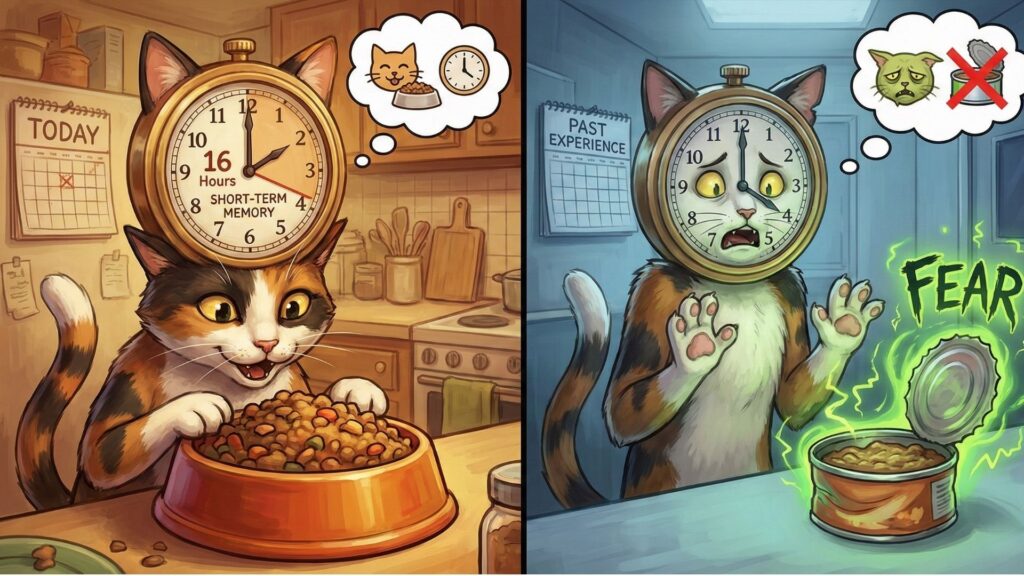
An intriguing comparison often surfaces in behavioral studies: while a dog’s short-term memory may last only about five minutes, cat short-term memory can last up to 16 hours. This strength allows them to track food sources and routines throughout the day.
However, how good is a cat’s memory when it comes to the long term? Long-term memory is heavily driven by negative associations. If a cat experiences conditioned taste aversion—getting sick after eating a specific food—they may avoid that flavor for years, linking the trauma to the scent through a powerful survival mechanism.

3. The Foundation of Taste: Kittenhood Development
A cat’s “flavor map” begins to form during the critical weaning period. The textures, smells, and proteins they are exposed to as growing kittens dictate their adult preferences. This is where “neophobia” (fear of the new) comes into play. If a kitten isn’t introduced to diverse food profiles early on, their memory registers any unfamiliar food as potentially “unsafe,” leading to what we perceive as pickiness (MamaPlus).
4. Nutritional Wisdom and the “Boredom” Mechanism
Have you ever seen your cat try to “bury” their food or suddenly walk away from a brand they’ve loved for months? This highlights how good is a cat’s memory for nutritional balance. Known as “nutritional wisdom,” cats instinctively seek variety to prevent nutrient deficiencies that might arise from a monotonous diet. Recent research in Vet Times suggests that cats select food based on specific macronutrient targets (protein vs. fat), and their memory helps them recognize when they need a change in their “menu.”
“Cats are obligate carnivores with high protein requirements. Their sense of taste is specialized to identify amino acids rather than sugars, which they cannot taste at all.”

5. Sensory Memory: The Power of Scent
A cat’s memory of food is primarily an “olfactory archive.” While humans have over 9,000 taste buds, cats have only a few hundred. To understand how good is a cat’s memory, we must realize they “taste” with their noses first. A high-quality raw diet or a protein-rich formula appeals to this archive. If the aroma matches the “nutrient profile” stored in their memory, the meal is accepted; if not, it is rejected before the first bite.
Conclusion: A Bond That Lasts
In the end, how good is a cat’s memory? It is good enough to remember the sound of your footsteps, the location of the treat jar, and the comfort of a reliable routine. Even after a month of absence, cats recognize their owners and the feeding rituals that define their lives. Every bowl you serve isn’t just a meal—it’s a lasting memory of safety and care in their clever, hunter minds.